Sunday, August 4, 2019

What is this devouring machine?

Why have we fed nearly all of our most beautiful lakes, rivers, and streams to a devouring machine, a human-created ‘god’ that has no consciousness, no ethics, no heart? This machine is called capitalism and it was created by humans; something made-up, just a ‘theory’ that was tried out on the whole world, an experiment that has gone very wrong, in which most of us are complicit. 

Many people may think that sacrificing to the gods is something humans did long ago, that giving the best foods, the best craftwork and art to the gods in order to give thanks and ensure a good harvest for all was ‘primitive.’ But we have simply twisted this beautiful practice of gratitude and respect, and instead we now sacrifice our oceans, our mountains, our forests, our freshwater, our air, to our god of capitalism everyday, so that we can have more and more and more, more plastic gadgets and games that break in a week, more garages and storage units filled with broken and unused crap that we never needed at all. And what about human sacrifice? That taboo subject that we are so sure we would never do? We sacrifice humans every day, every minute, to our god of capitalism. This god has an insatiable appetite for the poor and was first created on the backs of slaves and continues to be fed through the gaping maws of mining, dredging for tin and sand, sweatshops, children recycling dry-cell batteries in Bangladesh, mind-numbing and body destroying factory workers the world over… The list of its appetites goes on and on. This is human sacrifice. 

But instead of spending energy blaming, since we are almost all entangled in this gods grip, we can learn from this massive failure and participate in co-creating an economic system that is not a machine, that is not destroying our home, but is embedded in the laws of nature and reflects a deeper truth, that we are all – humans, animals, plants, minerals, the elements – part of the community of the Earth. It is an enormous task to be sure, as the economic system infiltrates almost every aspect of 'civilization' as we know it. But humans created this and humans can create something far better. We can create a living economy, an ecosystem economy that has parameters beyond which it simply can’t go, a system that can respond within the natural laws that do not poison one’s home and one’s body. We can stop feeding the machine that unthinkingly devours and start living in ways that support all life, build community, and feed what is truly valuable – human lives, animal lives, the soil, the water, the air, our capacity for compassion, reciprocity, gratitude, love – all the things that give meaning to our lives and help us to become true human beings. 

A big challenge is that while the creation of this god-machine mainly serves a very small percentage of people with the big winnings, it serves a large swath of the ‘middle classes’ with the crumbs, which are large enough and just satisfying enough to create a kind of complacency or sleepiness that allows people to look away, not think too deeply about things, and keep the machine fed at any cost. 

And when we create something new, are we going to simply find ways to continue this meaningless and insatiable consuming lifestyle but do it with less pollution and less waste? Is that all we really want? Is that the highest embodiment of humanity? Are we really just here on this amazing and awe-filled blue marble hanging in space to buy and sell mostly useless things? Is that it? If not, then we need to watch out, to pay attention, to not just settle for the green washing solutions.  Yes, to be sure, we need to find paints that aren’t toxic, substances that are truly biodegradable, methods that don’t create pollution and aren’t poisonous, and clean up all the messes, but can we also look deeper than this?  We’ve been under the spell of this inhuman machine for so long, we are in danger of forgetting our own humanness, our souls, the soul of the Earth… What are we really hungry for deep inside? Why do people feel so depressed, why all the suicides, the need for numbing drugs and alcohol? What happened to our human values, to the desire to give back, to make a contribution to the world, to be of service, to love and be loved, to care for the Earth, to feel grateful, to experience a deeply meaningful and well-lived life? None of that requires an unbalanced amount of worldly goods or useless stuff, right? So we can each start feeding that inhuman machine less and less. Step away and explore other much more interesting ways of life… To paraphrase Anne-Marie Bonneau @zerowastechef, “We don’t need millions of people doing this perfectly. We need millions of people doing it imperfectly.” 

While I don't feel that science will solve our folly–only a change in our consciousness, our attitudes, beliefs and understanding, can do that–I do think that science will certainly help clean up some of the messes and help us create nontoxic/biodegradable substances. I just watched a truly inspiring documentary called Inventing Tomorrow that follows several young people whose deep love of the Earth leads them to an international science fair competition where they bring their brilliant projects for cleaning up lakes in India, filtering the lead out of tin dredging waste water in Indonesia, and creating a photocatalytic paint that removes pollutants! The hard work and dedication of these young students is truly admirable: https://www.pbs.org/video/inventing-tomorrow-sxzrgx/


Underland by Robert Macfarlane

If you were to read only one book this year, make it this one! A lyrical exploration of the many mysterious activities that are happening or have happened beneath our feet... An interwoven feast of meaning, questions, philosophy, science, and stories. A rare and profound gift of a book.

"In this highly anticipated sequel to his international bestseller The Old Ways, Macfarlane takes us on an extraordinary journey into our relationship with darkness, burial, and what lies beneath the surface of both place and mind. Traveling through “deep time”—the dizzying expanses of geologic time that stretch away from the present—he moves from the birth of the universe to a post-human future, from the prehistoric art of Norwegian sea caves to the blue depths of the Greenland ice cap, from Bronze Age funeral chambers to the catacomb labyrinth below Paris, and from the underground fungal networks through which trees communicate to a deep-sunk “hiding place” where nuclear waste will be stored for 100,000 years to come. “Woven through Macfarlane’s own travels are the unforgettable stories of descents into the underland made across history by explorers, artists, cavers, divers, mourners, dreamers, and murderers, all of whom have been drawn for different reasons to seek what Cormac McCarthy calls “the awful darkness within the world.”

Global in its geography and written with great lyricism and power, Underland speaks powerfully to our present moment. Taking a deep-time view of our planet, Macfarlane here asks a vital and unsettling question: “Are we being good ancestors to the future Earth?” Underland marks a new turn in Macfarlane’s long-term mapping of the relations of landscape and the human heart. From its remarkable opening pages to its deeply moving conclusion, it is a journey into wonder, loss, fear, and hope. At once ancient and urgent, this is a book that will change the way you see the world."

Friday, September 9, 2016

The Blackhouse by Peter Mays

Just discovered The Lewis Trilogy - reading the first one, The Blackhouse... well done and a real page turner, though certainly grim.  All three mysteries take place on the Isle of Lewis in the Outer Hebridean Islands off the Northwest coast of Scotland.

More info:

The Blood of Flowers

"Set in the legendary time of Shah Abbas the Great, the novel captures the bustle of bazaars overflowing with pomegranates, rosewater and saffron; the breathtakingly beautiful silk and gold rugs of the Shah’s carpet workshop; and Isfahan’s incomparable bridges, gardens, teahouses, and hammams. With spellbinding medieval Persian tales and prose that flows like the Zayandeh River through the city of Isfahan, The Blood of Flowers is the story of one woman’s struggle to create a life of her choosing, relying—against all odds—on the strength of her own hands, mind and will."
More info:


Monday, July 22, 2013

The Samurai's Garden by Gail Tsukiyama

Truly an exquisite story! Beautifully rendered and timeless. This one will stay with you for a long time. She also wrote "Streetof a Thousand Blossoms," "One Hundred Flowers,""Women of the Silk," and "The Language of Threads."

"The daughter of a Chinese mother and a Japanese father, Tsukiyama uses the Japanese invasion of China during the late 1930s as a somber backdrop for her unusual story about a 20-year-old Chinese painter named Stephen who is sent to his family's summer home in a Japanese coastal village to recover from a bout with tuberculosis. Here he is cared for by Matsu, a reticent housekeeper and a master gardener. Over the course of a remarkable year, Stephen learns Matsu's secret and gains not only physical strength, but also profound spiritual insight."

More info:

Holy the Firm by Annie Dillard

One of my all-time favorite authors. She holds up a lens to life and then tilts it just so and you see things anew... gasping, jaw dropped, or laughing...

"The god of today is rampant and drenched. His arms spread, bearing moist pastures; his fingers spread, fingering the shore. He rises, new and surrounding; he is everything that is, wholly here and emptied--flung, and flowing, sowing, unseen, and flown."

"We are most deeply asleep at the switch when we fancy we control any switches at all. We sleep to time's hurdy-gurdy; we wake, if we ever wake, to the silence of God."

"Give the mind two seconds alone and it thinks it's Pythagoras"

More about her books here: http://www.anniedillard.com/books-annie-dillard.html

Wendell Berry's novels

What a find! He wrote around eight or nine novels about the village of Port William, KY and each one is beautifully written, filled with much wisdom about the land, people and in general how to get along with one another and how to truly care for this world. These novels as well as his poetry and essays are described here (including a map of Port William: http://www.wendellberrybooks.com/

Gilead by Marilynne Robinson

As this review states "...reading it is enough to inspire missionary fervor. You must read this book." I tend to mark passages in books with small colored tabs. My copy of this book has at least 30 tabs... A couple of quotes then:

"Nowhere in Scripture is there a father who behaves wickedly toward his child, but the rich and powerful in Scripture are wicked much more often than not."
"Feuerbach is a famous atheist, but he is about as good on the joyful aspects of religion as anybody and he loves the world. Of course he thinks religion could just stand out of the way and let joy exist pure and undisguised."

In the Springtime of the Year by Susan Hill

Beautiful, spare writing about a young village woman in England who is widowed at the age of 21
when her husband is killed while felling wood. Exquisite writing.
http://www.susan-hill.com

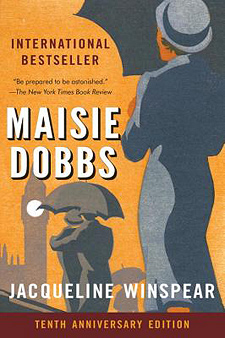
Maisie Dobbs Mystery Series by Jacqueline Winspear

Maisie Dobbs - Delightful series about a young British woman who sets herself up as a private investigator during the 1930s and 40s in London. She has been trained in a most unusual way and there is much wisdom in these books. Also interesting historically especially about the war, the trauma of the returning soldiers and medical personnel, and about forensics.

Tuesday, January 29, 2013

Housekeeping by Marilynne Robinson

I'll let a few quotes suffice. This is a beautifully crafted novel. Her dexterity with language reminds me of Anne Michaels (author of Fugitive Pieces). This book will stay with you.

"Every spirit passing through the world fingers the tangible and mars the mutable, and finally has come to look and not to buy."

"And the dear ordinary had healed as seamlessly as an image on water."

 more quotes>>

Monday, January 28, 2013

Instruments of Darkness / Anatomy of Murder by Imogen Robertson

Well written series, very descriptive and evocative of the 1780s in England. There are two more, Island of Bones and Circle of Shadows that I look forward to reading. 

"Instruments of Darkness combines the brooding atmosphere of the best of Daphne du Maurier with the complex, compelling detail of Tess Gerritsen, moving from drawing room to dissecting room, coffee shop to country inn, and into the shadowy heart of eighteenth-century society."

http://imogenrobertson.wordpress.com/the-books/

Thursday, December 6, 2012

The Art of Hearing Heartbeats by Jan-Philipp Sendker

The Art of Hearing Heartbeats is simply an exquisite story of unconditional love. Deeply moving and magical. Good to read along with the titles below by Jacques Lusseyran. Both books convey how visual sight really distracts us from truly seeing and experiencing anything at all. Very highly recommend!

Against the Pollution of the I by Jacques Lusseyran


This is a truly extraordinary collection of six essays. Every one is a gem. If you can't find a copy then borrow it from the library! This is one of the books I would want to have on a desert isle....

"Every once in a while a book is released that simply exalts the soul in ways that are universal, breathtaking, and marvelous. Here are six posthumous essays by Jacques Lusseyran (1924-1971), a French writer, teacher, and activist during World War II in the Resistance Movement. He was imprisoned at Buchenwald until the U.S. Third Army liberated him."

His autobiography, And Then There Was LIght, is equally as stunning.

Bodhisattva of Compassion: The Mystical Tradition of Kuan Yin by John Blofeld

Beautiful and illuminating book! I look forward to reading his other works.

"John Blofeld evokes the charming presence of Kuan Yin through colorful anecdotes, personal experiences, and descriptions of Buddhist rituals and legends encountered during his travels throughout China. At the same time, he offers a learned account of the goddess's history and importance in Chinese thought and religion. He explores the origin of the Bodhisattva of Compassion in India and Tibet, in the form of Avalokiteshvara (Tibetan: Chenresig), a male deity who evolved into the gentle mother/maiden figure of Chinese Buddhism. Meditation and visualization techniques associated with Kuan Yin are given, and her principal iconographic forms are described. Illustrated with images from Chinese and Tibetan sacred art, the book also contains translations of devotional poems and yogic texts. Bodhisattva of Compassion is undoubtedly the most complete and illuminating picture of Kuan Yin available."

Cloud Atlas by David Mitchell

I really enjoyed this, the writing is excellent and creative!
"Cloud Atlas consists of six nested stories that take the reader from the remote South Pacific in the nineteenth century to a distant,post-apocalyptic future. Each tale is revealed to be a story that is read (or observed) by the main character in the next. The first five stories are interrupted at a key moment. After the sixth story, the other five stories are returned to and closed, in reverse chronological order, and each ends with the main character reading or observing the chronologically previous work in the chain. Eventually, readers end where they started, with Adam Ewing in the nineteenth century South Pacific." 

Sunday, April 8, 2012

WASHOKU:Recipes from the Japanese Home Kitchen / KANSHA: Celebrating Japan's Vegan & Vegetarian Traditionsby Elizabeth Andoh

If you like simple home-style Japanese country cooking, you'll love Elizabeth Andoh's books. She also has three websites, one for each book offering more recipes and online workshops and archives.
http://www.WASHOKUcooking.com/
http://www.KANSHAcooking.com/
http://www.KIBOcooking.com/

Cutting for Stone by Abraham Verghese

This is one of my all time favorites. What a storyteller! His other two books, which are autobiographies are also good!
"The story is a riveting saga of twin brothers, Marion and Shiva Stone, born of a tragic union between a beautiful Indian nun and a brash British surgeon at a mission hospital in Addis Ababa. Orphaned by their mother's death in childbirth and their father's disappearance, and bound together by a preternatural connection and a shared fascination with medicine, the twins come of age as Ethiopia hovers on the brink of revolution.But it's love, not politics -- their passion for the same woman -- that will tear them apart and force Marion to flee his homeland and make his way to America, finding refuge in his work at an underfunded, overcrowded New York City hospital. When the past catches up to him, wreaking havoc and destruction, Marion has to entrust his life to the two men he has trusted least in the world: the surgeon father who abandoned him and the brother who betrayed him."

Ceremony by Leslie Marmon Silko

Beautifully crafted, very real understanding of PTSD  in soldiers. This is a must-read!
"Tayo, a young Native American, has been a prisoner of the Japanese during World War II, and the horrors of captivity have almost eroded his will to survive. His return to the Laguna Pueblo reservation only increases his feeling of estrangement and alienation. While other returning soldiers find easy refuge in alcohol and senseless violence, Tayo searches for another kind of comfort and resolution. Tayo's quest leads him back to the Indian past and its traditions, to beliefs about witchcraft and evil, and to the ancient stories of his people. The search itself becomes a ritual, a curative ceremny that defeats the most virulent of afflictions—despair."

Master of the Jinn by Irving Karchmar


Exquisitely beautiful, highly recommend this one!
"Here is a tale set on the Path of the Heart, a mystical adventure wherein a modern-day Sufi master sends seven companions on a quest for the original Ring of Power, and the greatest treasure of the ancient world - King Solomon's ring. It is the very same seal ring of a hundred legends, given to King Solomon by God to command the Jinn, those terrifying demons of living fire."